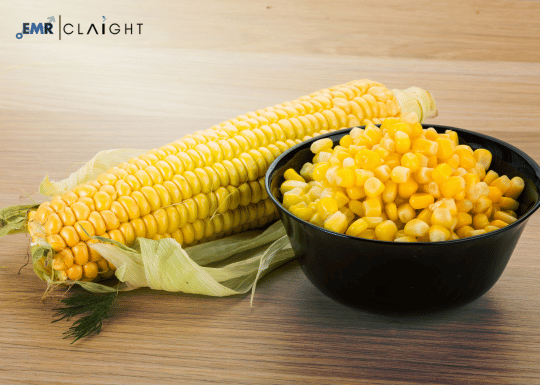
According to the report by Expert Market Research (EMR), the global corn market reached a volume of 1183.43 million metric tons (MMT) in 2024. Aided by the rising demand for corn in food, feed, and industrial applications, the market is projected to grow at a CAGR of 1.10% between 2025 and 2034 to attain a volume of approximately 1320.24 MMT by 2034.
Corn, also known as maize, is one of the most widely cultivated cereal grains globally and plays a critical role in global food security. It serves as a staple food in many countries, a major animal feed ingredient, and a key raw material in various industrial processes, including ethanol production, starch manufacturing, and bioplastics. With its versatile applications and high productivity, corn has cemented its place as a cornerstone in the global agricultural economy.
The increasing global population and rising food consumption are among the primary factors driving the corn market. As food security becomes a growing concern, especially in emerging economies, corn’s importance as a reliable and high-yield crop continues to rise. Additionally, the expanding livestock and poultry industries across Asia, Africa, and Latin America are boosting the demand for corn as a feed component.
Market Size
The global corn market has demonstrated consistent growth in recent years, reaching a substantial volume of 1183.43 MMT in 2024. This growth has been supported by favorable climatic conditions in major corn-producing regions such as the United States, China, Brazil, and Argentina, coupled with increasing government support and investments in agricultural research and technology.
Looking forward, the corn market is expected to maintain a steady growth trajectory, with projections indicating that it will reach approximately 1320.24 MMT by 2034. The expansion is being fuelled by the rising global demand for food and biofuels, continuous technological advancements in crop breeding, and the adoption of precision agriculture.
Get a Preview with a Free Sample Report
Market Share
The corn market is dominated by a few major producers, with the United States holding a leading position globally. The country accounts for a significant share of global production and exports, largely due to its advanced agricultural infrastructure and robust supply chain. Other major players include China, Brazil, Argentina, and Ukraine, each contributing considerably to the global supply of corn.
On the consumption side, Asia-Pacific remains the largest market due to its rapidly growing population and expanding livestock sector. China, in particular, has emerged as a major consumer, driven by its demand for animal feed and industrial use of corn. Meanwhile, North America remains a prominent player in the production and export of corn-based products such as ethanol and processed foods.
Market Trends
One of the key trends shaping the corn market is the increasing focus on biofuels. With growing concerns over climate change and fossil fuel dependence, many countries are turning to bioethanol, which is primarily derived from corn, as an alternative energy source. The United States and Brazil are at the forefront of this shift, with large-scale ethanol production facilities supported by favourable government policies.
Another notable trend is the rising adoption of genetically modified (GM) corn. GM varieties offer higher yields, resistance to pests and diseases, and improved drought tolerance, making them increasingly popular among farmers. These advancements are contributing to improved productivity and greater resilience in the face of changing climatic conditions.
In addition, there is a growing demand for organic and non-GMO corn products, particularly in North America and Europe, where consumers are becoming increasingly health-conscious and environmentally aware. This has led to the expansion of niche markets that cater to organic food and specialty grain segments.
Drivers of Growth
Several factors are driving the growth of the global corn market. The increasing demand for animal feed is a significant contributor, especially in developing regions where meat consumption is on the rise. Corn is a critical ingredient in poultry, cattle, and swine feed due to its high energy content and digestibility.
The food industry also plays a crucial role in market growth, as corn is used in a wide range of products such as corn flour, corn oil, sweeteners (like high-fructose corn syrup), and breakfast cereals. The versatility of corn in culinary applications and its nutritional value continue to drive its consumption globally.
Moreover, the expanding ethanol industry has become a vital growth driver. As countries seek to reduce carbon emissions and transition to renewable energy sources, the demand for corn-based biofuels is expected to increase further in the coming years.
Challenges and Opportunities
Despite its strong outlook, the global corn market faces several challenges. Climate change poses a significant threat to corn production, as extreme weather events such as droughts, floods, and heatwaves can adversely impact yields. Additionally, the overuse of chemical fertilizers and pesticides has raised environmental and health concerns, prompting stricter regulations and the need for more sustainable farming practices.
Price volatility is another major challenge. Corn prices are influenced by a range of factors, including weather conditions, geopolitical tensions, trade policies, and currency fluctuations. This unpredictability can affect both producers and consumers and lead to market uncertainty.
However, the market also presents numerous opportunities. The development of drought-tolerant and disease-resistant corn varieties through biotechnology offers the potential to increase productivity and reduce environmental impact. Furthermore, the growing demand for corn-based bioplastics and sustainable packaging solutions opens up new avenues for industrial use.
Emerging markets in Asia and Africa offer significant growth potential due to rising population, urbanization, and income levels. Investments in infrastructure, irrigation, and farmer education can help unlock these opportunities and drive market expansion.
Market Forecast
The future of the global corn market appears promising, supported by stable demand across food, feed, and fuel segments. As per EMR projections, the market is expected to grow at a CAGR of 1.10% from 2025 to 2034, reaching a volume of 1320.24 MMT by the end of the forecast period.
Government initiatives promoting biofuel usage, technological advancements in seed development, and sustainable farming practices are likely to play pivotal roles in supporting long-term growth. The shift towards precision agriculture and digital farming is expected to enhance productivity and resource efficiency, further contributing to the market’s development.
Continued investments in agricultural infrastructure, storage facilities, and transportation will be essential to manage supply chain challenges and reduce post-harvest losses. Collaborations between governments, research institutions, and private companies will be key to fostering innovation and resilience in the corn sector.

